
- Poet
- A.E. Housman (England)
- Syllabus theme
- Conflict
- Form
- Ballad: six four-line stanzas, rhyme scheme abab
- Speaker
- A young farmer who has killed his brother, speaking to his friend Terence
- Key idea
- A sudden, violent family tragedy and the exile that follows
About the poet
Alfred Edward Housman was born in 1859 in Worcestershire, England, the eldest of seven children, and died in 1936 in Cambridge. He was a brilliant classical scholar who became Professor of Latin, first at University College, London, and later at Cambridge.
As a poet he published only two volumes during his life: A Shropshire Lad (1896) and Last Poems (1922). A Shropshire Lad became very popular, especially during the Boer War and the First World War. Its poems deal with pastoral beauty, unrequited love, fleeting youth, grief and death. "Farewell to Barn and Stack and Tree" comes from this collection.
Background
As the original LitHelp notes explain, Housman first planned to call the book "Poems of Terence Hearsay". Terence is the fictional speaker of most of the poems, an ordinary young man from a farm in rural Shropshire who tells mostly dark stories about his own life and his neighbours. In this poem, Terence is the listener: a friend comes to him to confess a terrible crime and say goodbye.
The original notes also point out a parallel with the Bible story of Cain and Abel, in which one brother, a "tiller of the ground", kills the other and is sent away into exile. In Housman's version the murderer confesses not to God but to a sympathetic friend.
The poem is prescribed under the theme Conflict, with "War is Kind", "The Terrorist, He's Watching" and "Breakfast". Here the conflict is not a war but a violent quarrel within one family.
Setting
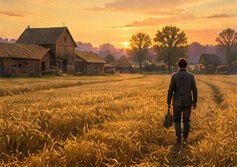
A farm in rural Shropshire, England, near the River Severn, at hay-making time. The peaceful countryside (barn, haystack, trees, the "half-mown hill") contrasts sharply with the violence that has just happened there.
| Word | Meaning |
|---|---|
| stack / rick | A large pile of hay or corn |
| Severn | The river that flows through Shropshire |
| scythe and rake | Farm tools for cutting and gathering grass |
| Lammastide | A traditional English harvest festival in early August |
| fold | An enclosure for sheep |
Synopsis
A young farmer says farewell to his home and to the countryside along the River Severn. He tells his friend Terence to look at him for the last time, because he will never come home again. On the half-mown hill, his brother Maurice lies dead among the hay with his knife in his side. Their mother thinks they are still away working; that morning she had two sons, but tonight she will be alone. He offers Terence his bloody hand to shake and says goodbye. He wishes Terence strength, love and luck at the races at Lammastide. Finally, he imagines the haystack, the sheepfold and the dinner plate waiting for him in vain.
Stanza-by-stanza analysis
Stanza 1"Farewell to barn and stack and tree,
Farewell to Severn shore.
Terence, look your last at me,
For I come home no more.
The poem opens with a sad farewell. The repetition of "Farewell" and the polysyndeton (repeated "and": barn and stack and tree) list the familiar, loved things of farm life he must leave. The direct address "Terence" makes it a dramatic monologue. "Look your last at me" and "I come home no more" are final and shocking. We do not yet know why he must leave, which creates suspense.
Stanza 2"The sun burns on the half-mown hill,
By now the blood is dried;
And Maurice amongst the hay lies still
And my knife is in his side."
The terrible reason is revealed. The peaceful farm image of "the half-mown hill" contrasts horribly with "the blood is dried". "Half-mown" shows the work was interrupted suddenly. "Maurice amongst the hay lies still" is a calm, understated way of saying he is dead. The final line is blunt and chilling: "my knife is in his side." The murderer does not explain why he did it, and this silence makes the tragedy more mysterious.
Stanza 3"My mother thinks us long away;
'Tis time the field were mown.
She had two sons at rising day,
To-night she'll be alone.
The speaker thinks of his mother, who does not yet know. "Thinks us long away" is dramatic irony: she imagines her sons are simply working late. The contrast between "two sons at rising day" and "To-night she'll be alone" sums up the tragedy in a single day: one son dead, the other an exile. This creates deep pathos.
Stanza 4"And here's a bloody hand to shake,
And oh, man, here's good-bye;
We'll sweat no more on scythe and rake,
My bloody hands and I.
He offers Terence his "bloody hand", a shocking image of his guilt. "Oh, man" is colloquial and emotional, the voice of an ordinary young farmer. The repetition of "bloody" stresses that the blood can never be washed away. "We'll sweat no more on scythe and rake, / My bloody hands and I" treats his hands almost as a separate companion (personification), and shows that his life of honest farm work is over. This is the extract set in the 2016 exam.
Stanza 5"I wish you strength to bring you pride,
And a love to keep you clean,
And I wish you luck, come Lammastide,
At racing on the green.
Surprisingly, he turns from his own disaster to wish his friend well: strength, pride, a good love that keeps him "clean" (innocent, unlike himself), and luck at the Lammastide races. The kind wishes show his warmth and friendship, and make the tragedy even sadder, because he will never share these ordinary pleasures again.
Stanza 6"Long for me the rick will wait,
And long will wait the fold,
And long will stand the empty plate,
And dinner will be cold."
The poem ends with images of the farm waiting for someone who will never return. The anaphora ("And long … And long … And long") gives a slow, mournful rhythm. "The empty plate" and "dinner will be cold" are simple domestic details that create strong pathos. The cold dinner suggests both the absent brothers and the cold finality of death.
Themes
- Violence and conflict within the familyA brother kills a brother: the most painful kind of conflict, reflecting the story of Cain and Abel.
- GuiltThe "bloody hands" stay with him; he cannot escape what he has done.
- Exile and loss of home"For I come home no more": he must leave everything he loves.
- A mother's grief"She had two sons at rising day, / To-night she'll be alone."
- FriendshipEven in despair, he thinks kindly of Terence and wishes him well.
- Loss of innocenceThe original notes link the poem to the archetypal pattern of loss of innocence, and the Eden-like farm the youth must leave because of his sin.
Literary techniques
| Technique | Example | Effect |
|---|---|---|
| Ballad form | Quatrains, abab rhyme, simple language, a tragic story | Dramatic, song-like and easy to remember |
| Dramatic monologue | "Terence, look your last at me" | We hear a private confession |
| Repetition | "Farewell … Farewell"; "bloody hand … bloody hands" | Sadness; inescapable guilt |
| Polysyndeton | "barn and stack and tree" | Lists everything he loves and must leave |
| Contrast | "half-mown hill" / "the blood is dried"; "two sons" / "alone" | Peaceful farm life against violent death |
| Understatement | "Maurice amongst the hay lies still" | Calm words make the horror more shocking |
| Dramatic irony | "My mother thinks us long away" | We know what she does not; pathos |
| Imagery | "a bloody hand to shake"; "the empty plate" | Guilt and absence made visible |
| Anaphora | "And long … And long … And long" | Slow, mournful ending |
| Colloquial language | "oh, man" | The authentic voice of an ordinary farm boy |
Tone
Sad, regretful and resigned. The speaker is calm, almost numb with shock, and never explains or defends his crime. Moments of warmth (his wishes for Terence) make the tragedy more moving.
Context questions (Part I, Section A)
Each extract carries 5 marks: (a) text and author, 1; (b) speaker, person spoken to, or situation, 2; (c) inference or response, 2.
"We'll sweat no more on scythe and rake,
My bloody hands and I"
- In which work do these lines appear? Who is the poet? 1
- Who are referred to as "we"? What will they not do? 2
- Why does the speaker describe his hands as bloody? 2
Show model answer (by LitHelp)
(a) "Farewell to Barn and Stack and Tree" by A.E. Housman.
(b) "We" refers to the speaker and his "bloody hands". They will no longer work on the farm with scythe and rake, because he must leave home for ever.
(c) Because he has just killed his brother Maurice with a knife. The blood on his hands is a sign of his crime and his guilt.
"Terence, look your last at me,
For I come home no more."
- Name the poem and the poet. 1
- Who is speaking to Terence? Why will he "come home no more"? 2
- What effect do these lines have at the opening of the poem? 2
Show model answer
(a) "Farewell to Barn and Stack and Tree" by A.E. Housman.
(b) A young farmer who has killed his brother Maurice is speaking to his friend Terence. He must flee and can never return home because of his crime.
(c) They create suspense and a sense of sadness and finality. We know something terrible has happened, but not yet what.
"She had two sons at rising day,
To-night she'll be alone."
- From which poem is this extract taken? Who wrote it? 1
- Who is "she"? Why will she be alone? 2
- Comment on the contrast in these lines. 2
Show model answer
(a) "Farewell to Barn and Stack and Tree" by A.E. Housman.
(b) "She" is the speaker's mother. She will be alone because one son, Maurice, has been killed, and the other, the speaker, must run away for ever.
(c) The contrast between "two sons at rising day" and "alone" at night shows how completely her life has been destroyed in a single day. It creates strong pathos.
Essay questions (Part II, Poetry)
Content 7 · Organisation 4 · Language 4.
"Farewell to Barn and Stack and Tree" uses the ballad form to present a powerful family tragedy. Discuss. 15
Show model answer
A.E. Housman's "Farewell to Barn and Stack and Tree" is a short ballad in which a young farmer confesses to his friend Terence that he has killed his brother Maurice and must leave home for ever. Through the simple, dramatic ballad form, Housman presents a deeply moving family tragedy.
The ballad form suits the story. It has six quatrains with a regular abab rhyme scheme, simple language and a tragic event at its centre, like traditional ballads. As the original LitHelp notes observe, the short dialogue and repetition make it "full of suspense" and dramatic. The poem opens with a farewell, "Terence, look your last at me, / For I come home no more", but does not explain why, so the reader waits anxiously for the truth.
The tragedy is revealed with shocking simplicity: "And Maurice amongst the hay lies still / And my knife is in his side." The peaceful image of "the half-mown hill" contrasts with "the blood is dried", and the calm understatement ("lies still") makes the horror greater. The speaker never explains why he killed his brother, which leaves the reader to imagine the quarrel. The original notes compare this with the Bible story of Cain and Abel.
The tragedy spreads to the whole family. The mother "thinks us long away", unaware of what has happened. The contrast "She had two sons at rising day, / To-night she'll be alone" shows a family destroyed in a single day. The speaker's guilt is shown through the repeated image of blood: "here's a bloody hand to shake" and "My bloody hands and I".
Yet he remains warm and human. He wishes Terence strength, love and "luck, come Lammastide", which makes us pity him even more. The final stanza, with its mournful anaphora ("And long … And long … And long") and the images of "the empty plate" and the cold dinner, shows the farm waiting for sons who will never return.
In conclusion, through the ballad form, suspense, contrast, understatement, repetition and simple domestic imagery, Housman turns one violent moment into a powerful tragedy of guilt, exile and loss.
How does Housman create pathos in "Farewell to Barn and Stack and Tree"? 15
Show answer plan
- Introduction: pathos means feelings of pity and sorrow; the poem is full of them.
- The farewell: repeated "Farewell"; the loved farm scenes; "I come home no more".
- The dead brother: "lies still" among the hay; understatement.
- The mother: dramatic irony in "thinks us long away"; "two sons … alone".
- Guilt: the "bloody hand to shake".
- Kindness: his wishes for Terence's future.
- The ending: the waiting rick and fold, "the empty plate", the cold dinner.
- Conclusion: we pity everyone: the dead brother, the mother, and even the murderer.
- Saying Terence is the murderer. Terence is the listener; the speaker is the murderer, and Maurice is the victim.
- Inventing a reason for the murder as if it were fact. The poem does not say why. You may suggest possibilities, but say clearly that they are interpretations.
- Forgetting the mother. She is central to the poem's pathos.
Quick revision
Video and quiz
Now try this quiz…
Farewell to Barn and Stack and Tree
by A. E. Housman · O/L Literature Interactive Quiz