
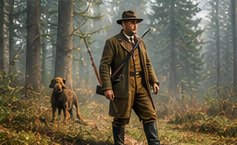
- Poet
- Edward Lowbury
- Syllabus theme
- Humour
- Form
- Narrative poem in five six-line stanzas, told like a folk tale
- Source
- An African folk tale
- Key idea
- Careless, excessive talk can destroy the talker
About the poet
Edward Lowbury was a modern English poet. Unusually for a poet, he was also a doctor and a medical scientist, and he wrote poetry alongside his scientific career. His poems are usually short, clear and carefully controlled, and many of them are built around a single striking idea.
"The Huntsman" shows these qualities well. Lowbury takes an old African folk tale and retells it in plain, simple language, leaving the story to make its own point. He does not tell us the moral directly; we discover it through the action.
Background
The poem is based on an African folk tale. Folk tales are traditional stories passed down by word of mouth from one generation to the next. They often contain magical or supernatural elements (here, a talking skull), simple characters, and a lesson about how to live.
As the original LitHelp notes put it, the story "explains the uncertainty of human life" and is "full of suspense, mystery and the supernatural". The lesson is a very old one, found in many cultures: think before you speak. Sri Lankan students may compare it with sayings such as "Speech is silver, silence is golden".
In the O/L syllabus "The Huntsman" is prescribed under the theme Humour, together with "The Camel's Hump", "Upside Down" and "Two's Company". The humour here is dark humour: it comes from irony and absurdity, even though the story ends in death.
Setting
The poem moves between two places:
- The bush and the forest: the wild, lonely world of the hunter, where Kagwa finds the skull. This is a place of mystery and the supernatural.
- The king's court: the world of power and authority, where Kagwa reports what he has seen and where the king makes his harsh decision.
No date or exact country is given. Like most folk tales, the story seems to take place "once upon a time", which makes its lesson feel universal.
Synopsis (the story in brief)
- Kagwa, a hunter, is hunting lions in the bush and forest. He finds the skull of a man and asks it how it came there. The skull opens its mouth and answers, "Talking brought me here."
- Amazed, Kagwa hurries home and tells the king that he has found a talking skull. The king is silent, then says slowly that he has never heard of a skull that speaks.
- The king sends two guards with Kagwa to find the skull. He orders that if Kagwa's story is a lie, and the skull does not speak, Kagwa himself must die.
- After searching for days and nights, they find the skull. Kagwa asks it the same question, but the skull says nothing, even when Kagwa begs it to speak.
- The guards make Kagwa kneel and kill him with sword and spear. Then the skull opens its mouth and asks, "Huntsman, how did you come here?" The dead man answers, "Talking brought me here."
Line-by-line analysis
Stanza 1: the hunter meets the skull
Lines 1–2Kagwa hunted the lion,
Through bush and forest went his spear.
The poem opens directly, like a folk tale, by naming the hero and his occupation. Kagwa is a brave man: he hunts the most dangerous animal, the lion. Line 2 uses inversion (the normal order would be "his spear went through bush and forest"), which gives the line a traditional, story-telling rhythm. The spear stands for Kagwa himself (a kind of metonymy), and the alliteration of "bush" and the stress on "forest" suggest wide, wild country.
Lines 3–4One day he found the skull of a man
And said to it, "How did you come here?"
"One day" is another folk-tale phrase. The skull is an image of death. It is already strange that Kagwa speaks to a skull; it shows his curiosity and his habit of talking. His question, "How did you come here?", becomes a refrain that is repeated twice more in the poem.
Lines 5–6The skull opened its mouth and said,
'Talking brought me here.'
Here the supernatural enters the poem: the skull answers. Its reply is a warning, although Kagwa does not understand it. The skull is personified: it opens its mouth and speaks like a person. This short, mysterious line is the key to the whole poem, and it returns, word for word, at the very end.
Stanza 2: Kagwa reports to the king
Lines 7–9Kagwa hurried home;
Went to the king's chair and spoke:
'In the forest I found a talking skull.'
"Hurried" shows Kagwa's excitement and haste. He does not stop to think about the skull's warning; he rushes to tell the most powerful person in the land. "The king's chair" (the throne) stands for royal power. Ironically, Kagwa is now doing exactly what the skull warned against: talking.
Lines 10–12The king was silent. Then he said slowly,
'Never since I was born of my mother
Have I seen or heard of a skull which spoke.'
The king's silence and slow speech contrast sharply with Kagwa's hurry. The king is cautious and thoughtful; Kagwa is hasty. "Never since I was born of my mother" is a formal, old-fashioned way of saying "never in my whole life". It shows that the king does not believe the story, and it creates suspense: we wonder what he will do.
Stanza 3: the king's order
Lines 13–15The king called out his guards:
'Two of you now go with him
And find this talking skull;
The king acts with authority. He wants proof, so he sends guards to test Kagwa's story.
Lines 16–18But if his tale is a lie
And the skull speaks no word,
This Kagwa himself must die'
The king's condition is harsh: a man will die if a skull does not talk. The words "This Kagwa" sound cold and dismissive, as if Kagwa does not matter. These lines foreshadow Kagwa's death and raise the tension. They also show the danger of reporting to people in power: careless words can cost a person their life.
Stanza 4: the silent skull
Lines 19–20They rode into the forest;
For days and nights they found nothing.
"For days and nights" stretches out the time and builds suspense. The long, fruitless search makes us wonder whether the skull really exists.
Lines 21–24At last they saw the skull; Kagwa
Said to it, "How did you come here?"
The skull said nothing. Kagwa implored,
But the skull said nothing.
Kagwa repeats his question, the second time we hear it. The repetition of "the skull said nothing" stresses the skull's silence and Kagwa's helplessness. "Implored" means begged desperately: the confident hunter is reduced to pleading with a skull. This is the climax. Ironically, the skull now does what Kagwa should have done: it stays silent.
Stanza 5: the twist
Lines 25–26The guards said, 'Kneel down.'
They killed him with sword and spear.
The execution is told in very few, flat words. There is no description of feelings, which makes the moment shocking. "Sword and spear" echoes Kagwa's own spear in line 2: the hunter is now the hunted.
Lines 27–30Then the skull opened its mouth;
'Huntsman, how did you come here?'
And the dead man answered,
'Talking brought me here.'
The ending is a powerful twist and a perfect example of situational irony. The skull speaks only after Kagwa is dead, and now it asks Kagwa's own question. There is a role reversal: the skull asks, and the dead hunter answers with the skull's own words. Kagwa has become another talking skull, so the poem ends where it began, a circular structure. The moral is complete without the poet ever stating it: his talking brought him to his death.
Themes
- The danger of excessive, careless talk. This is the central theme. Kagwa ignores the skull's warning and rushes to report something he cannot prove. As the 2016 marking scheme points out, the poem is not against talking in general, only against excessive, worthless talking.
- Silence and discretion. The skull's silence at the crucial moment teaches the value of knowing when not to speak.
- Power and authority. The king's harsh condition shows how dangerous it can be to speak carelessly before people in power. The original LitHelp notes stress this lesson: "one should be very careful when talking to others and especially to men of authority."
- The uncertainty of life and fate. One encounter in the forest changes Kagwa's fate completely. The circular ending suggests that the same mistake can be repeated by anyone.
- The supernatural and mystery. The talking skull belongs to the world of folk tale and magic, and creates an atmosphere that is "gloomy and fearful".
Literary techniques
| Technique | Example | Effect |
|---|---|---|
| Refrain / repetition | "How did you come here?" / "Talking brought me here." | Links the beginning and end; makes the moral memorable |
| Repetition | "The skull said nothing … But the skull said nothing." | Stresses the skull's silence and Kagwa's helplessness |
| Situational irony | The skull speaks only after Kagwa is dead | Creates the shocking twist and dark humour |
| Role reversal | The skull asks Kagwa's question; the dead man gives the skull's answer | Shows Kagwa sharing the skull's fate |
| Circular structure | The poem ends with the line it first used | Suggests the mistake can be repeated by anyone |
| Personification | "The skull opened its mouth and said" | Creates the supernatural, mysterious atmosphere |
| Contrast | "Kagwa hurried" vs "The king … said slowly" | Haste and rashness against caution and thought |
| Dialogue / direct speech | The skull, Kagwa, the king and the guards all speak | Makes the poem dramatic, like a short play |
| Inversion | "Through bush and forest went his spear" | Gives a traditional, story-telling rhythm |
| Foreshadowing | "This Kagwa himself must die" | Builds suspense and tension |
| Simple diction | Short, plain words and sentences | Suits a folk tale; makes the ending more shocking |
Examiners expect you to explain why a poem about death counts as humour. The 2016 marking scheme lists: irony (the skull keeps quiet when it matters), the contrast between Kagwa the brave lion hunter and Kagwa the foolish talker, the role reversal at the end, and the absurdity of a man talking to a skull, a brainless skull that talks, and a skull that "keeps quiet" when it feels threatened.
Tone and mood
The tone is calm and matter-of-fact, like a storyteller who has told the tale many times. The mood is gloomy, mysterious and suspenseful, ending in shock. Beneath the seriousness lies a dry, dark humour that makes the reader smile at Kagwa's foolishness even as he dies.
Context questions (Part I, Section A)
Each extract carries 5 marks: (a) name the text and the author, 1 mark; (b) the speaker, the person spoken to, or the situation, 2 marks; (c) your inference or response, such as attitude, meaning or a literary device and its effect, 2 marks.
"The king was silent. Then he said slowly,
'Never since I was born of my mother
Have I seen or heard of a skull which spoke.'"
- From which poem is this extract taken? Who wrote it? 1
- Whom is the king speaking to, and what has that person just told him? 2
- What attitude does the king show in these lines? 2
Show model answer
(a) "The Huntsman" by Edward Lowbury.
(b) The king is speaking to Kagwa, the huntsman, who has hurried home to tell him that he found a talking skull in the forest.
(c) The king is doubtful and disbelieving: he has never heard of a skull that speaks. His silence and slow speech also show that he is cautious and thoughtful, in contrast with Kagwa's haste.
"But if his tale is a lie
And the skull speaks no word,
This Kagwa himself must die"
- Name the poem and the poet. 1
- Who speaks these words? To whom are they spoken? 2
- What do these lines suggest about what will happen next? 2
Show model answer
(a) "The Huntsman" by Edward Lowbury.
(b) The king speaks these words to his guards, as he sends two of them with Kagwa to find the talking skull.
(c) The lines foreshadow Kagwa's death. They build suspense because Kagwa's life now depends on whether a skull will speak, which also shows how harsh and dangerous the king's power is.
"The skull said nothing. Kagwa implored,
But the skull said nothing."
- From which poem is this extract taken? Who wrote it? 1
- Describe the situation in which these lines occur. 2
- Name a literary device used here and explain its effect. 2
Show model answer
(a) "The Huntsman" by Edward Lowbury.
(b) After searching for days and nights, Kagwa and the king's guards find the skull. Kagwa asks it, "How did you come here?", but the skull does not answer.
(c) Repetition ("the skull said nothing") emphasises the skull's silence and Kagwa's helplessness. It increases the suspense, because Kagwa's life depends on the skull speaking. (Irony is also acceptable: the skull stays silent, which is exactly what Kagwa failed to do.)
"Then the skull opened its mouth;
'Huntsman, how did you come here?'
And the dead man answered,
'Talking brought me here.'"
- Name the poem and the poet. 1
- Who is "the dead man"? Why is he dead? 2
- What is ironic about these lines? 2
Show model answer
(a) "The Huntsman" by Edward Lowbury.
(b) "The dead man" is Kagwa, the huntsman. The king's guards have just killed him because the skull did not speak, so his story seemed to be a lie.
(c) The skull speaks only after Kagwa has been killed for saying it could speak. There is also a role reversal: the skull asks Kagwa's question and Kagwa gives the skull's answer, showing that his own talking has brought him to his death.
Essay questions (Part II, Poetry)
Content 7: relevant facts from the text, well chosen, with your own response. Organisation 4: answers the question, has a clear introduction, development and conclusion, and supports points with quotations at the right moment. Language 4: correct grammar, good vocabulary and expressive style.
"Excessive, worthless talking may ruin people." This idea is portrayed through humour in Edward Lowbury's "The Huntsman". Discuss. 15
Points the 2016 marking scheme looks for
- The poem is not about talking in general, but about excessive, worthless talking.
- The skull's answer to Kagwa's question, "Talking brought me here", shows the result of excessive, worthless talking.
- The information Kagwa gives the king is of no real concern to the king, which shows it is worthless talk.
- Kagwa's death shows the result of unnecessary talking.
- Humour comes from irony in this sad incident.
- Kagwa as a hunter of lions can be contrasted with his conduct as a talker and bearer of news.
- The role reversal of Kagwa and the skull brings out humour.
- Absurdity: Kagwa talking to a skull; a brainless skull talking; the skull keeping quiet when it feels threatened.
- Better answers relate the lesson to people today and may refer to the saying "silence is golden".
Show model answer
Edward Lowbury's "The Huntsman" retells an African folk tale about Kagwa, a hunter who finds a talking skull. Although the story ends in Kagwa's death, it is told with a dry, dark humour, and through that humour the poet shows how excessive and worthless talking can ruin a person.
The poem does not condemn talking in general. Its target is talk that is careless and unnecessary. When Kagwa asks the skull "How did you come here?", it replies, "Talking brought me here." This mysterious answer is a clear warning, but Kagwa ignores it. Instead, he "hurried home" and announced to the king, "In the forest I found a talking skull." The news is of no real use to the king; it is gossip about a wonder that Kagwa cannot prove. His haste contrasts with the king, who "was silent" and spoke "slowly", and this contrast shows that Kagwa speaks without thinking.
The result is disastrous. The king orders that if the skull "speaks no word, / This Kagwa himself must die." When the skull stays silent, Kagwa "implored" it in vain, and the guards kill him "with sword and spear". His unnecessary talk has cost him his life.
Lowbury presents this tragedy through humour. The main source is irony: the skull, which spoke freely to Kagwa, falls silent at the very moment Kagwa needs it, and speaks again only after he is dead. There is also humour in the contrast between Kagwa the brave lion hunter and Kagwa the foolish talker who ends up begging a skull. The situation is absurd too: a grown man chats with a skull, a brainless skull talks, and then it cleverly "keeps quiet" when danger appears. Finally, the role reversal at the end, where the skull asks Kagwa's question and "the dead man" replies, "Talking brought me here", gives the story a neat, grimly comic twist. Kagwa has become another talking skull.
The lesson is still relevant today. People who spread rumours, boast, or speak carelessly before those in power can bring trouble on themselves. As the saying goes, silence is golden. Through irony, contrast, absurdity and role reversal, Lowbury makes us smile at Kagwa's foolishness while making sure we remember the serious warning behind it.
Discuss how Edward Lowbury uses repetition and dialogue to create suspense in "The Huntsman". 15
Show answer plan
- Introduction: a folk tale told almost entirely through speech; suspense builds towards a twist.
- The refrain: "How did you come here?" asked three times; "Talking brought me here" at the start and the end. Each repetition raises the question of whether the skull will speak.
- The king's speech: his slow words and his condition, "This Kagwa himself must die", put Kagwa's life at stake.
- The search: "For days and nights they found nothing" delays the outcome.
- The silence: "The skull said nothing … But the skull said nothing" is the climax, where repetition shows Kagwa's helplessness.
- The twist: the final dialogue releases the suspense with irony and role reversal.
- Conclusion: simple language plus repetition and dialogue make the poem dramatic and memorable, and drive home the moral.
"The Huntsman warns us about the dangers of speaking carelessly before those in power." Do you agree? 15
Show answer plan
- Introduction: agree; the poem warns against careless talk, especially before people in authority.
- Kagwa takes unproven news straight to "the king's chair", the seat of power.
- The king's power over life and death: his harsh condition and the cold phrase "This Kagwa".
- The guards carry out the order without question: "Kneel down."
- Contrast between the cautious king and the rash Kagwa.
- Wider lesson: careless words to people in power can have serious consequences in families, schools and workplaces as well.
- Balance: the main point is still excessive and worthless talk in general, and the skull's warning applies to everyone.
- Conclusion: the humour (irony, role reversal) makes the warning memorable.
- Saying the poem is against all talking. It is about excessive, careless talk.
- Mixing up the two speakers of "Talking brought me here": first the skull (stanza 1), then the dead Kagwa (stanza 5).
- Calling the poem simply "funny". Explain the dark humour: irony, contrast, role reversal and absurdity.
- Retelling the story without analysing it. Every point should explain an effect or connect to the question.