
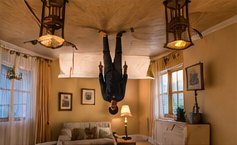
- Poet
- Alexander Kushner (Russia); studied in English translation
- Syllabus theme
- Humour
- Form
- Humorous narrative poem in rhyming quatrains with a closing couplet
- Main character
- "Upside-Down", a man who does everything the wrong way round
- Key idea
- The comedy, and the loneliness, of someone who does not conform
About the poet
Alexander Kushner was born in 1936 in Leningrad (now St Petersburg), Russia. He worked as a schoolteacher from 1959 to 1969 before becoming a full-time writer, and he has published more than thirty books of poetry. The poet Joseph Brodsky called him one of the best lyric poets of the twentieth century.
Kushner's poetry is known for its modesty and closeness to everyday life: it looks carefully at ordinary objects and people. "Upside Down" shows his lighter side, a playful poem for young readers built around one comic idea.
Background
"Upside Down" belongs to the tradition of comic poems about "topsy-turvy" characters who do everything backwards. Readers laugh at their absurd mistakes, but such poems often carry a gentle lesson about how society treats people who are different.
"Upside Down" is prescribed under the theme Humour, with "The Camel's Hump", "The Huntsman" and "Two's Company". Be ready to explain what makes it funny and what serious idea lies underneath.
Setting
The poem is set in an ordinary town: a bridge, a river, a restaurant, a visiting circus and a postman delivering letters. The everyday setting makes Upside-Down's strange behaviour stand out even more.
Synopsis
A man called Upside-Down is "the talk of all the town" because he always does things the wrong way round. Told to turn right, he turns left. In a boat, he cannot understand why he is floating or what has happened to the land. He reads and writes "backside-fore", so "ton" becomes "not". He is afraid to cross bridges and wades through rivers instead. In a restaurant, he orders a pair of socks. When the circus comes, people say he is funnier than the clown. At the end, he receives a letter from his aunt but cannot decide whether he should, or can, read it. As the original LitHelp notes explain, the poem closes with a couplet suggesting that you must "behave as others do" if you want people to respect you.
Stanza-by-stanza analysis
Stanza 1Once there lived an Upside-Down
Who was the talk of all the town.
If he was told to turn to right
He turned to left out of spite.
"Once there lived" is a fairy-tale opening. The man has no real name, only a nickname that describes his behaviour, which suggests that the town sees him only as a joke. "The talk of all the town" shows he is famous for the wrong reasons. "Out of spite" suggests he deliberately does the opposite of what he is told. The rhyming couplets (Down/town, right/spite) give a bouncy, comic rhythm.
Stanza 2If he went sailing in a boat
No one could make him understand
Why he seem to be afloat
And what had happened to the land.
Upside-Down is confused by the simplest facts: he does not understand why a boat floats or why the land seems to disappear. "No one could make him understand" suggests he cannot learn the way other people do, which hints at his isolation. The humour comes from the absurdity of his confusion.
Stanza 3He read his letters backside-fore,
And wrote his letters backside-fore.
So if a "ton" was to be read
He read it "not," the dunder-head!
The repetition of "backside-fore" (an invented, comic form of "back to front") emphasises how consistently he gets things wrong. The wordplay of "ton" read as "not" is a neat example: the letters reversed make a completely different word. "Dunder-head" is an old, humorous word for a stupid person. It shows the town's mocking attitude, and the exclamation mark adds to the fun.
Stanza 4All his life he was afraid
To cross a bridge. He'd always wade
(Unless the water was too deep
Or the embankment was too steep.)
He is afraid of the very thing that makes crossing a river safe, the bridge, and prefers the harder, more dangerous way. This is an irony of reversed logic. The words in brackets add a comic, practical afterthought: even Upside-Down has limits.
Stanza 5He went into a restaurant;
The waiter said, "What do you want?"
He said, "I'd like a pair of socks
With clocks on them, and in a box."
Direct speech turns this into a little comic scene. Ordering socks in a restaurant is completely absurd. "Clocks" here means the patterns woven on the sides of socks, a playful pun on the other meaning of "clock". The rhymes socks/clocks/box make the request sound even sillier.
Stanza 6The circus came to town one day;
Of course he went without delay.
And everyone said Upside-Down
Was funnier than the circus clown.
The professional clown is paid to make people laugh, but Upside-Down does it without trying. This is funny, yet also a little sad: people see him only as entertainment. The comparison with the clown links to the poem's deeper theme of the outsider.
Stanza 7Just yesterday the postman brought
A letter to him from his aunt:
"Shall I read it? P'raps I ought,
P'raps I will, p'raps I can't."
The poem moves to the present ("Just yesterday"). The repetition of "P'raps" (perhaps) shows his indecision and uncertainty: he cannot even decide whether to read a letter. The original notes point out that here he seems "very unsure of himself and his abilities". The colloquial "P'raps" makes his voice sound natural and comic.
Closing couplet, as quoted in the original LitHelp notesYou must behave as others do
If they're to have respect for you
The poem ends with what sounds like a moral. As the original notes explain, it is ambiguous: the poet may be giving sincere advice, or may be ironic, gently criticising a society that "looks askance at anything which is unconventional even if it is something positive".
Themes
- Humour and absurdityThe poem's comedy comes from the unpredictability and absurdity of Upside-Down's behaviour.
- ConformityThe closing couplet raises the question of whether we must behave like everyone else to be respected.
- The outsiderUpside-Down is a social "misfit", though not an anti-social character. The town laughs at him rather than with him.
- Loneliness and alienationThe original notes suggest the poet also sympathises with him, conveying the loneliness caused by his inability to conform.
- Self-doubtIn the last stanza he is unsure even of himself: "P'raps I can't."
Literary techniques
| Technique | Example | Effect |
|---|---|---|
| Rhyming couplets and simple rhythm | Down/town, right/spite, socks/clocks | Light-hearted, bouncy, easy to remember |
| Nickname as a name | "Upside-Down" | He is defined only by his oddness |
| Wordplay | "ton" read as "not" | Clever, comic example of his backwardness |
| Absurdity | Ordering socks in a restaurant | Creates laughter |
| Direct speech | "What do you want?"; "Shall I read it?" | Makes scenes lively and dramatic |
| Repetition | "backside-fore"; "P'raps" | Emphasis; shows his consistency and indecision |
| Comparison | "funnier than the circus clown" | Humour, with a hint of sadness |
| Colloquial language | "P'raps", "dunder-head" | Natural, chatty, comic tone |
| Irony / ambiguity | The closing moral | Leaves readers asking whether the advice is sincere |
Tone
The tone is light-hearted, playful and comic, matching the easy rhythm. Underneath, there is a note of sympathy for the lonely outsider, and the ending is open to interpretation.
Context questions (Part I, Section A)
Each extract carries 5 marks: (a) text and author, 1; (b) speaker, person spoken to, or situation, 2; (c) inference or response, 2.
"If he was told to turn to right
He turned to left out of spite."
- From which poem are these lines taken? Who wrote it? 1
- Who is "he"? Why is he "the talk of all the town"? 2
- What does "out of spite" suggest about him? 2
Show model answer
(a) "Upside Down" by Alexander Kushner.
(b) "He" is Upside-Down, a man famous in his town because he always does everything the wrong way round.
(c) It suggests that he deliberately does the opposite of what he is told, out of stubbornness or ill will, which makes him seem difficult and odd to others.
"So if a 'ton' was to be read
He read it 'not,' the dunder-head!"
- Name the poem and the poet. 1
- Why does he read "ton" as "not"? 2
- Identify a literary device here and explain its effect. 2
Show model answer
(a) "Upside Down" by Alexander Kushner.
(b) Because he reads and writes "backside-fore" (back to front), so the letters of "ton" are reversed into "not".
(c) Wordplay: reversing "ton" gives "not", a clever, funny example of his backwardness. The word "dunder-head" and the exclamation mark add mocking humour.
"And everyone said Upside-Down
Was funnier than the circus clown."
- From which poem is this extract taken? Who wrote it? 1
- Describe the situation. 2
- What does this comparison suggest about how the town sees Upside-Down? 2
Show model answer
(a) "Upside Down" by Alexander Kushner.
(b) The circus has come to town, and Upside-Down goes to it at once. People find him more amusing than the professional clown.
(c) The town sees him only as a figure of fun, someone to laugh at rather than understand. This hints at his loneliness as a social misfit.
"Shall I read it? P'raps I ought,
P'raps I will, p'raps I can't."
- Name the poem and the poet. 1
- Who speaks these words, and about what? 2
- What do these lines reveal about the speaker? 2
Show model answer
(a) "Upside Down" by Alexander Kushner.
(b) Upside-Down speaks them about a letter from his aunt that the postman has just brought.
(c) The repeated "P'raps" shows his indecision and lack of confidence: he is unsure of himself and his abilities, even about something as simple as reading a letter.
Essay questions (Part II, Poetry)
Content 7 · Organisation 4 · Language 4.
"Upside Down is a humorous poem with a serious message." Discuss. 15
Show model answer
Alexander Kushner's "Upside Down" tells the story of an eccentric man who does everything the wrong way round. On the surface it is a comic poem for young readers, but beneath the humour lies a serious message about conformity and the loneliness of the outsider.
The humour comes mainly from the absurdity and unpredictability of Upside-Down's behaviour. Told to turn right, "He turned to left out of spite." He reads and writes "backside-fore", so that "ton" becomes "not", a clever piece of wordplay. Afraid of bridges, he wades through rivers instead, and in a restaurant he orders "a pair of socks / With clocks on them, and in a box." The bouncy rhyming couplets, colloquial words such as "dunder-head" and "P'raps", and lively direct speech make these scenes even funnier. No wonder the town thinks he is "funnier than the circus clown."
Yet the poem also invites sympathy. Upside-Down has no real name, only a nickname that marks him as odd, and he is "the talk of all the town" for the wrong reasons. People laugh at him, but no one seems to help him: "No one could make him understand." In the last stanza he cannot even decide whether to read his aunt's letter: "P'raps I will, p'raps I can't." His uncertainty suggests loneliness and self-doubt. As the original LitHelp notes observe, the poet conveys a sense of alienation caused by his inability to conform.
The serious message is clearest in the closing couplet: "You must behave as others do / If they're to have respect for you." This may be sincere advice, but it may also be ironic. Society often refuses to respect anything unconventional, even when it is harmless or positive. The poem leaves us to decide whether Upside-Down should change, or whether the town should be kinder.
In conclusion, "Upside Down" makes us laugh through absurd situations, wordplay and lively rhythm, but it also makes us think about how we treat people who are different. That combination of humour and seriousness is what makes the poem memorable.
Discuss how Alexander Kushner creates humour in "Upside Down". 15
Show answer plan
- Introduction: a comic portrait of a man who does everything backwards.
- Absurd situations: the boat, wading instead of using bridges, socks in a restaurant.
- Wordplay: "ton" and "not"; "clocks" on socks.
- Sound and rhythm: rhyming couplets and a simple metre.
- Language: colloquial "P'raps", "dunder-head", and the nickname "Upside-Down".
- Direct speech: the restaurant scene and the letter.
- Comparison: "funnier than the circus clown".
- Conclusion: the humour also has a gentle, sympathetic edge.
- Calling the poem "just funny". Show the serious ideas of conformity and loneliness too.
- Not explaining the "ton"/"not" joke. Say clearly that the letters are reversed.
- Treating the closing moral as definitely sincere. Mention that it may be ironic.